Composite Deck Building Guide: Framing, Spacing & Costs
Following a dedicated composite deck building guide before framing your backyard platform keeps you from voiding a 25-year manufacturer warranty or watching expensive capped boards buckle and sag in July heat. Two summers ago, I inspected a 14-by-20-foot composite deck in Michigan where the installer had reused old 16-inch-on-center joists and tight butt joints without expansion gaps, causing the boards to bow upward and rip hidden fastener clips straight out of the grooves.
Capped composite and PVC decking behave completely differently from pressure-treated pine because polymer boards expand lengthwise in direct sunlight and flex more between joists. Tightening joist spacing to 12 inches on center, leaving exact thermal expansion gaps at butt seams, and protecting the wood frame underneath with butyl joist tape gives you a low-maintenance outdoor space that stays flat for decades.
Composite Deck Building Guide Overview
Key facts to know first
Realistic composite decking material and installation costs in 2026
For a standard 12-by-16-foot (192-square-foot) backyard platform, capped composite deck boards (such as Trex Enhance, TimberTech Prime+, or Fiberon) cost $4 to $9 per linear foot, putting total DIY material costs at $4,800 to $7,200 including pressure-treated framing, concrete piers, and hidden fasteners. Hiring a certified composite deck contractor averages $45 to $75 per square foot installed depending on railing style and stair complexity.
Why 12-inch joist spacing and stair stringer spacing are mandatory
While 2×6 pressure-treated pine spans 16 inches on center without noticeable bounce, most composite manufacturers require 12-inch on-center joist spacing for residential builds (and 9-to-12-inch spacing for diagonal 45-degree board layouts). Stair stringers under composite treads also require 9-to-12-inch on-center spacing so treads never flex under heavy foot traffic.
Prepping adjacent house masonry and siding before framing
Once your ledger board and rim joists are bolted against the house, reaching the lower brick foundation or siding behind the framing becomes nearly impossible. If your foundation wall needs coating first, follow proven exterior masonry painting tips, and check local forecasts carefully for exterior painting when it rains or exterior painting when humid before sealing adjacent wood trim.
What most people get wrong
Installing composite boards with tight zero-gap butt joints
Capped composite boards expand and contract lengthwise along their grain as outdoor temperatures swing from 20°F in January to 95°F in August. According to the American Wood Council (AWC) DCA 6 Prescriptive Residential Wood Deck Construction Guide and leading composite installation standards, builders must follow manufacturer-specified end-to-end thermal expansion gaps (typically 1/8 to 3/16 inch depending on ambient installation temperature) and strip siding back to install continuous ledger flashing before framing.
Skipping butyl joist tape over pressure-treated framing lumber
Capped composite boards easily last 25 to 35 years, yet the pressure-treated Southern Yellow Pine joists underneath will rot in 12 to 15 years if rainwater pools inside screw holes. Applying self-adhering butyl flashing tape across the top edge of every joist, rim board, and beam seals fastener punctures and keeps your substructure alive as long as the composite surface.
Step-by-step composite deck building guide checklist for DIYers
Follow these five installation practices so your composite boards lay flat, drain cleanly, and pass municipal framing inspections.
-
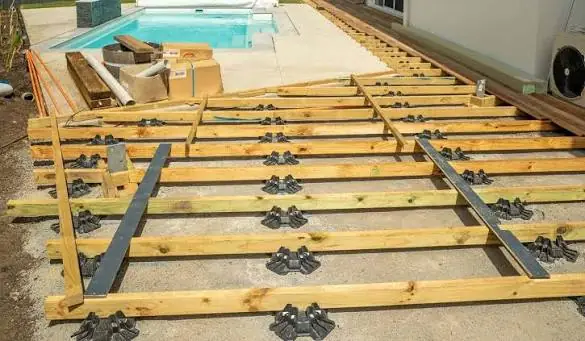
Frame at 12 inches on center and plane crowned joists flat: Sight down every 2×10 joist so crowns face up, and shave any high joists flush with a power hand planer because composite boards telegraph every 1/8-inch framing hump across the surface.
-
Apply butyl joist tape and double picture-frame blocking: Cover all top joist faces with black butyl tape, and install double blocking along perimeter edges to support picture-frame border boards and breaker boards cleanly.
-
Acclimate composite boards on site and stagger butt seams: Stack boards flat off the ground for 48 hours before fastening, and use full-width perpendicular breaker boards instead of end-to-end butt joints whenever deck length exceeds 16 or 20 feet.
-
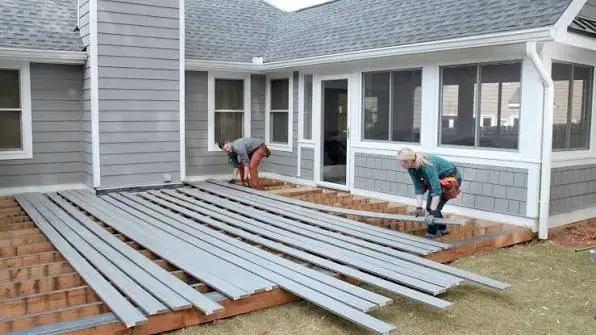
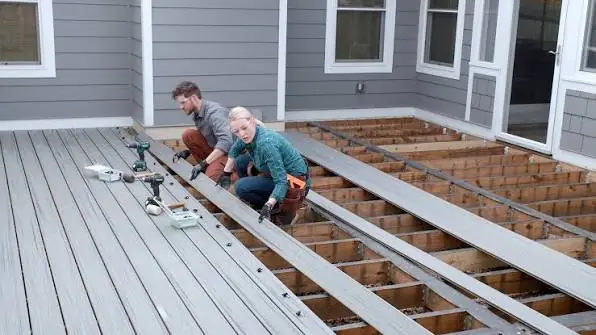
Use grooved-edge boards with stainless steel hidden clip fasteners: Slide manufacturer-approved hidden fasteners (such as Trex Hideaway or CAMO Edge Clips) into side grooves for a screw-free walking surface, reserving color-matched cortex composite screws and plugs for perimeter starter and picture-frame boards.
-
Leave 1/4-inch clearance against house walls and solid posts: Never jam composite boards tight against brick siding, patio doors, or 6×6 guardrail posts, which blocks airflow and causes buckling during peak afternoon sun.
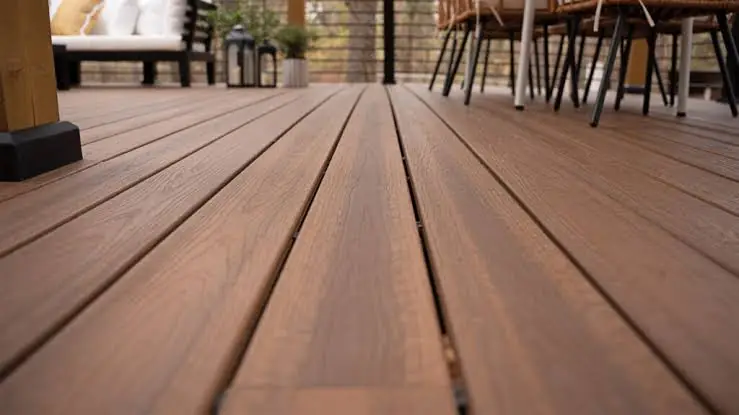
Choosing between capped wood-plastic composite and 100% cellular PVC
Capped wood-plastic composite (WPC) wraps a recycled wood-and-polyethylene core inside a durable polymer shell, offering great scratch resistance and natural weight at $4 to $7 per linear foot. Cellular PVC decking (such as TimberTech Azek) contains zero organic wood fibers, making it 30% lighter, cooler underfoot, and completely immune to moisture absorption around pools or docks at $7 to $11 per linear foot.
Cleaning composite decking without voiding the surface cap warranty
Composite boards never need sanding, staining, or water sealing, yet pollen and shaded north-wall mildew can still form dark spots over time. Wash your deck twice a year with mild dish soap, warm water, and a soft-bristle deck brush, and keep pressure washers below 1,500 PSI using a wide 40-degree fan nozzle held at least 12 inches off the surface.
Frequently Asked Questions
What is the most important rule in a composite deck building guide?
The most critical rule in any composite deck building guide is tightening joist spacing to 12 inches on center, leaving proper thermal expansion gaps at board ends and wall transitions, and applying butyl joist tape over pressure-treated framing. Skipping 12-inch spacing or expansion gaps causes boards to sag, buckle, and void manufacturer warranties.
Can I put composite deck boards over existing 16-inch wood joists?
Only if the existing pressure-treated joists are completely rot-free, level, and explicitly approved by your chosen composite brand’s span chart—most require 12-inch on-center spacing for residential warranties. If your current joists sit 16 inches apart, adding new pressure-treated joists between existing bays (reducing spacing to 8 inches) and applying butyl tape is the safest retrofit.
How much gap do composite deck boards need between them?
Leave a 3/16-inch to 1/4-inch side-to-side drainage gap between parallel composite boards (most hidden clip fasteners set this gap automatically). For end-to-end butt joints, leave a 1/8-inch gap in warm weather (above 70°F) or a 3/16-inch gap when installing in cool weather below 50°F to allow summer expansion.
Is composite decking worth the extra upfront cost over pressure-treated wood?
Yes, if you plan to stay in your home for more than five to seven years. While composite decking costs roughly twice as much upfront as pressure-treated pine, you save $400 to $800 every two years in power washing, sanding, and wood stain, and the boards never splinter, warp, or need replacement for 25 to 35 years.
Ready to Build Your Low-Maintenance Composite Deck?
Using a clear composite deck building guide comes down to framing joists 12 inches on center, sealing the timber substructure with butyl tape, and leaving exact thermal expansion gaps at every wall and breaker board. Measure your backyard layout this weekend, order board samples from two or three composite brands to test heat and traction in direct afternoon sun, and verify your local permit and frost-line footing requirements before purchasing framing lumber.